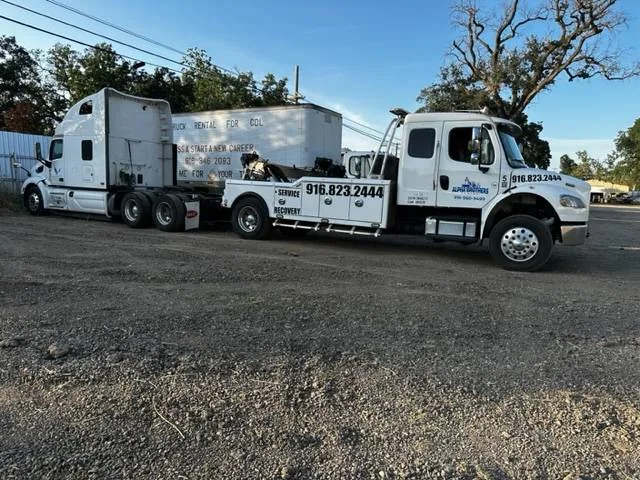
If a tractor‑trailer is down on I‑5 or I‑80, you need heavy‑duty towing fast. Here’s what semi‑truck towing involves, the equipment pros use, what it costs, and how to get 24/7 help across Greater Sacramento.
Moving 80,000 pounds safely off a busy interstate takes the right plan, crew, and equipment. If your tractor‑trailer is disabled on I‑5, I‑80, US‑50, or CA‑99 around Sacramento, heavy‑duty towing keeps freight moving and traffic flowing. This guide breaks down what semi‑truck towing really is, the wreckers and gear involved, what drives cost, and how to get reliable 24/7 help from North Natomas to Elk Grove, and West Sacramento to Roseville and Folsom. Whether it’s a blown steer tire in summer heat, a jackknife in tule fog, or a failed driveline at the Yolo Causeway, the right response protects your rig, your load, and your driver. Read on for practical tips and local insight drawn from daily work on Sacramento’s corridors.
What Semi-Truck Towing Really Means
Semi-truck towing is heavy-duty work built around Class 7–8 vehicles, often weighing up to 80,000 pounds. It covers straight tows, winch-outs, rollovers, load shifts, and full recoveries. The goal is to stabilize, move, and transport a tractor, trailer, or combination while protecting the powertrain, suspension, and load. Unlike light-duty, heavy towing uses underlifts sized for commercial axles, frame forks, and specialized rigging. Correct hookups keep axles and driveline safe. Depending on the failure, techs may pull axles or disconnect the driveline to prevent transmission damage. Air and electrical lines are secured and tested, and brake systems are managed so the unit rolls and stops as intended. Done right, a heavy tow clears the lane quickly and gets you to a shop or yard without adding damage.
Heavy-Duty Wreckers: Built for Semis
Heavy wreckers are purpose-built machines. Common specs include multi-axle chassis, 35–75‑ton booms, twin or quad 25,000–50,000 lb winches, and long‑reach underlifts rated for commercial axles. Rotators swing the boom 360 degrees to upright trailers or lift from tight spots without closing extra lanes. Other features matter on I‑5 and I‑80: wireless controls for precision, stability systems and outriggers, air supply to charge brake systems, and lighting for night work. The right wrecker lets an operator lift, winch, and tow a semi safely in narrow shoulders, on ramps, and at interchanges like I‑80/US‑50 and the I‑5/CA‑99 split.
Equipment Used in Heavy Recoveries
Beyond the truck itself, recovery gear makes the job. Operators use Grade 80/100 chains, synthetic straps, spreader bars, and snatch blocks to multiply pulling power and control angles. Frame forks, axle forks, and special attachments connect safely to commercial frames and suspension points. For uprights and load shifts, you’ll see cribbing, skates, and sometimes air cushions to gently roll trailers without crushing walls. Lowboys and Landoll-style trailers handle disabled or specialty equipment moves. On load transfers, forklifts or pallet jacks may be staged so freight can be reset before the tow. Every shackle and hook is rated and inspected, because in heavy work, rigging quality is the difference between a clean recovery and a secondary accident.
Semi Incidents We See on I‑5 & I‑80
Local conditions shape the calls. Summer heat near Elk Grove and West Sacramento cooks tires and wheel ends. Tule fog along the Yolo Causeway reduces visibility and contributes to jackknifes. Tight ramps at the I‑80/Antelope Rd and US‑50/Zinfandel interchanges see frequent breakdowns during rush hour. We also handle ditch pulls near rural stretches north toward Woodland, load shifts leaving distribution hubs in Rancho Cordova, and shoulder-limited scenes through Arden‑Arcade, Carmichael, and Citrus Heights. Eastbound I‑80 climbs toward Rocklin and Roseville, where grades and traffic combine to test cooling systems and brakes.
Need help now?
24/7 Towing & Roadside Across Greater Sacramento
Live dispatcher answers immediately — 20-30 min average ETA.
What Affects the Cost of Heavy Towing
Pricing depends on equipment, scene complexity, time on site, miles, and any load handling or hazmat. Typical factors include hookup type, winching or uprighting, need for a rotator, lane closures or traffic control, off‑pavement access, after‑hours conditions, and storage. Ballpark numbers in our region: standard heavy tow with hookup and local transport can run $750–$1,500+. Hourly wrecker rates often range $250–$450; rotators $650–$1,200. Loaded miles commonly bill $8–$12 per mile. Recovery scenes with winching, load shifts, or uprighting vary widely, but two to four hours with appropriate gear is common. Additional items can include scene materials, air‑cushion work, forklift time, and secure storage. Every job is different; a clear quote starts with accurate details on your unit, load, location, and condition.
Choosing a 24/7 Heavy-Duty Towing Partner
Look for a company with true heavy capacity, not just a big-looking truck. Ask about boom and underlift ratings, number of heavy units available 24/7, and operator credentials such as WreckMaster or TRAA training. Verify insurance, permits, and that they work safely with CHP and Caltrans on freeway scenes. You want straight pricing, realistic ETAs, and a dispatch team that understands commercial equipment. Yard access, storage options, and the ability to coordinate load transfers are a plus. At Alpha Brothers Towing, we staff experienced heavy operators and maintain purpose-built equipment so you get a safe, efficient solution day or night.
Driver Tips While You Wait
Safety first. Get to the right shoulder or a safe refuge if possible, set hazards, and place triangles per FMCSA guidance. If you’re on a narrow shoulder like the Yolo Causeway, it may be safer to stay behind a barrier and wait for law enforcement and your tow. Call with specifics: tractor and trailer type, axle count, approximate weight, load description and any hazmat placards, failure symptoms, and exact location (direction of travel and nearest exit or mile marker). Avoid spinning the drive tires, and don’t uncouple or pull axles unless instructed. Secure keys, paperwork, and photos of the scene and load condition for the shop and your dispatcher.
Greater Sacramento Coverage, Fast Response
Heavy-duty calls don’t wait. Reliable coverage should span I‑5, I‑80, US‑50, CA‑99, and CA‑65, plus major freight hubs, railyards, and distribution centers. In Greater Sacramento that includes West Sacramento, Arden‑Arcade, Carmichael, Citrus Heights, Rancho Cordova, Roseville, Rocklin, Folsom, and Elk Grove. Traffic, weather, and incident type drive arrival times, but efficient dispatch and multiple heavy units reduce downtime. Clear directions to the scene and good communication speed things up so lanes reopen sooner and your rig gets to the right shop or yard on the first move.
24/7 Semi Towing—Call (916) 960-9499
When you need heavy-duty help on I‑5, I‑80, US‑50, or CA‑99, call Alpha Brothers Towing at (916) 960‑9499. Since 2013, our Sacramento team has handled complex heavy tows and recoveries with care and speed. We’re available 24/7 and backed by 4.8 stars and 500+ reviews. Tell us your unit, load, and location, and we’ll dispatch the right wrecker, rotator, and gear. From West Sacramento and Downtown to Roseville, Rocklin, Folsom, Elk Grove, and beyond, we’ll get you moving again safely.
Stranded in Sacramento?
One call connects you to a live dispatcher. 20-30 min average ETA, 24/7, 365 days a year.
Alpha Brothers Towing
Sacramento's locally-owned towing and roadside assistance company. Serving Greater Sacramento since 2013 with a full fleet of light, medium, and heavy-duty trucks.