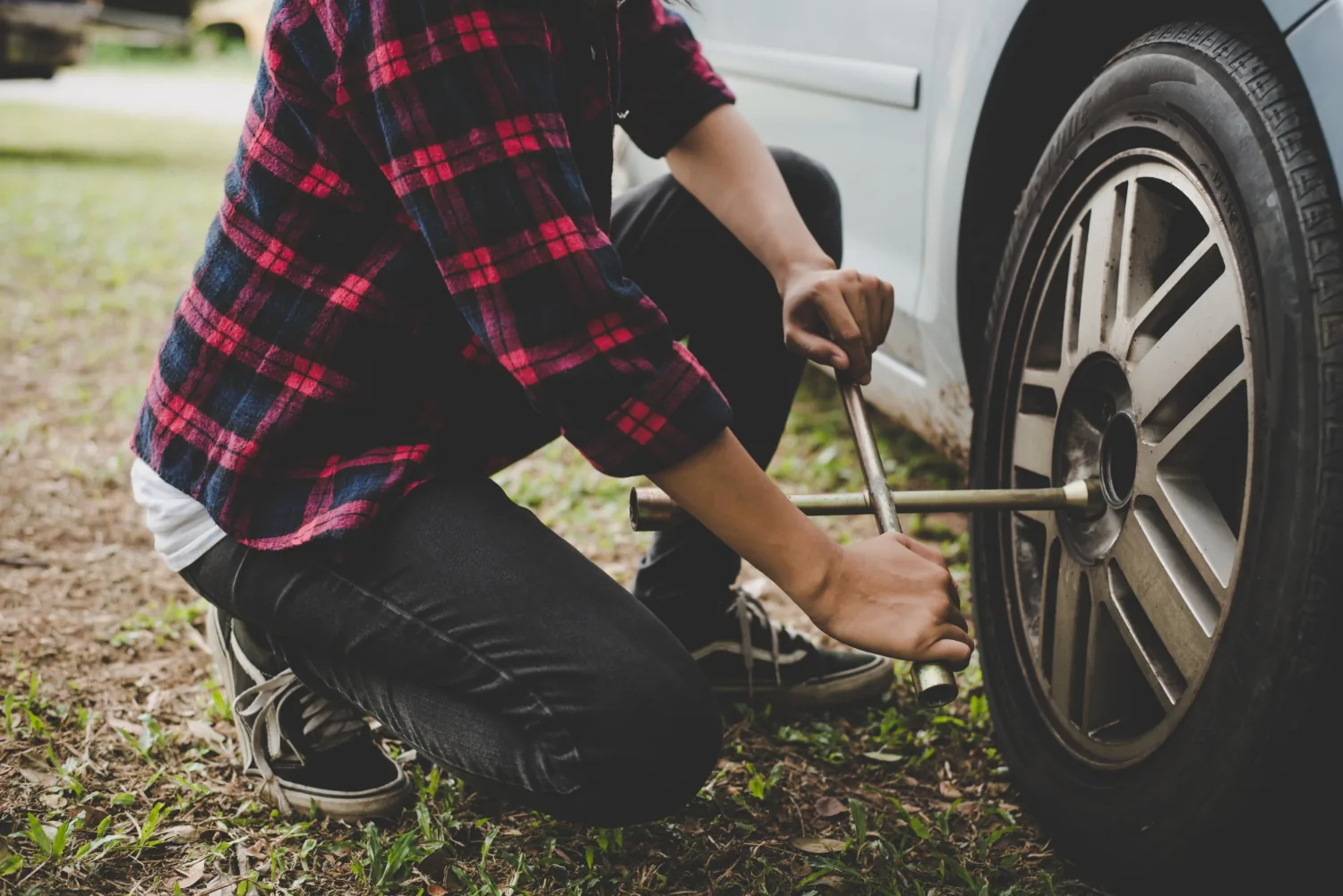
Tires are the only thing connecting your car to Sacramento's roads. Here are the warning signs that mean it's time to replace them — before a blowout makes the decision for you.
Tires are the most overlooked safety component on any vehicle. They handle every steering input, brake stop, and acceleration burst, yet most drivers wait until a flat or blowout before thinking about replacement. Sacramento's mix of summer heat, freeway miles, and rough city streets accelerates wear faster than people realize. Here are the seven signs that tell you it's time for new rubber.
1. Tread depth below 4/32 inch
The legal minimum in California is 2/32 of an inch, but real-world traction starts dropping off long before that. By 4/32, wet stopping distances increase dramatically and hydroplaning risk climbs. Use the quarter test: insert a quarter into a tread groove with Washington's head down. If you can see the top of his head, you're at or below 4/32 — time to shop. The penny test (Lincoln's head) only catches you at 2/32, which is already legally bald.
2. Uneven wear patterns
Bald spots on the inside, outside, or center of the tread mean something other than mileage is wearing your tires out. Center wear suggests over-inflation. Edge wear points to under-inflation. One-sided wear usually means alignment issues. Cupping or scalloping signals worn shocks or struts. Replacing tires without fixing the underlying issue just burns through a new set in half the expected lifespan.
3. Cracks, bulges, or sidewall damage
Sacramento summers regularly hit triple digits, and that heat dries out rubber compounds. Look for fine cracks in the sidewall (called dry rot), bulges that signal internal belt damage, and any cuts deeper than the surface. A bulge is a tire that's already failing — it can blow out at highway speed without warning. Replace immediately if you see one.
4. Tires older than 6 years
Even tires with plenty of tread degrade with age. Manufacturers and most tire safety experts recommend replacement at 6 years regardless of tread depth, and absolutely no later than 10 years. Find the DOT code on the sidewall — the last four digits are the week and year of manufacture (e.g., 3219 = the 32nd week of 2019). If your tires are older than your last car, replace them.
Need help now?
24/7 Towing & Roadside Across Greater Sacramento
Live dispatcher answers immediately — 20-30 min average ETA.
5. Vibration, pulling, or road noise
New vibrations in the steering wheel or seat, pulling to one side, or unusual humming can indicate tire problems. Sometimes it's a balance issue that can be corrected, but it can also mean separated belts inside the tire — a serious failure waiting to happen. Have a tire shop inspect immediately if symptoms appear suddenly.
6. Frequent pressure loss
If you're filling the same tire every couple of weeks, you have a slow leak. Common causes include nail punctures, valve stem failure, or wheel bead corrosion. Some can be patched cheaply. But if a tire has been driven on while flat, even briefly, the sidewall is likely compromised and the tire should be replaced rather than repaired.
7. After any blowout or hard impact
Hit a serious pothole on Highway 50, clipped a curb in Midtown, or had a freeway blowout? Even if the tire holds air, internal damage may have occurred. Have it inspected. And blowouts almost always mean replacing the damaged tire — and often its pair on the same axle, so the tread depths match.
Stuck with a flat? Call Alpha Brothers
If you're already on the side of the road in Sacramento, Roseville, Folsom, or anywhere in the metro, Alpha Brothers Towing offers fast mobile flat tire service and emergency towing 24/7. We'll change to your spare on-site or tow you to your preferred shop. Call (916) 960-9499 anytime — we answer the phone.
Stranded in Sacramento?
One call connects you to a live dispatcher. 20-30 min average ETA, 24/7, 365 days a year.
Alpha Brothers Towing
Sacramento's locally-owned towing and roadside assistance company. Serving Greater Sacramento since 2013 with a full fleet of light, medium, and heavy-duty trucks.